1.
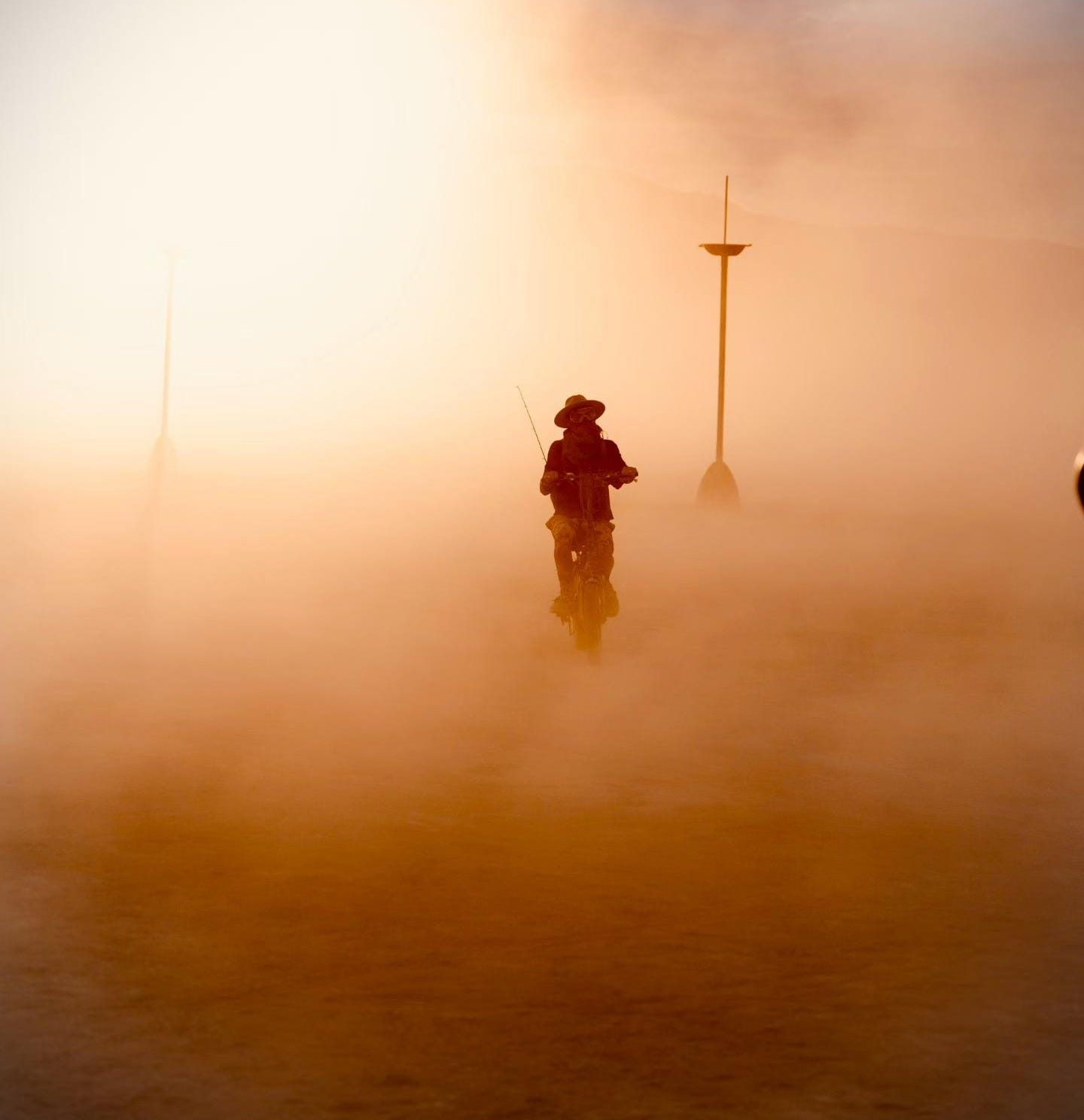
Three years later, I gave myself over to Black Rock City once again.
Three years earlier, I had come to Black Rock City because of a call I never answered. Someone had tried to reach me in San Francisco by satellite phone. I was convinced the call had come from Black Rock City. I could barely eat or sleep. By the following evening, I’d thrown my things together and set off. I did find the person I was looking for. But what followed—with an almost embarrassing lack of subtlety—mirrored the ending of Burning Man itself that year: first, a deluge, falling for no reason at all, washing everything apart; then a great fire, burning it all clean away. The wind took even the ashes.
Why had I come back? Why now, of all times? I couldn’t say.
For years, the same dream had been coming back to me.
It was winter. The wasteland was frozen to the bone, the ground split into long, raw cuts, one after another, as though someone had taken a knife to the earth and forgotten to clean up afterward. I was a snake. Snakes must shed their skins. My scales were poisonous, and down they came, one by one, each one a word. Wherever a scale fell, it burned a little black hole into the soil. I knew every one of those words: things I had said, names I had been called, verdicts handed down upon me.
When the last scale fell, I ran naked.
Ran. Ran forward.
There was nothing ahead of me. Nothing behind. The wind had a hardness to it, striking my bare skin like thrown stones. I wanted to hurl this body against the edge of the world, batter my way through, and see what lay beyond! I wanted “being alive” to mean being alive, nothing more, nothing else…
Round and round I would go, naked under that stony wind. If I froze to death circling that wasteland, so be it!
Every time, the dream broke there.
I woke to darkness. I lay still, waiting for my heartbeat to slow. Yet I felt as though I were standing at the edge of a cliff, with no idea who had put me there. It was pitch-black and misty, a place where day and night had never been told apart.
I kept murmuring the same words: What am I supposed to do? I said them to myself, and I said them to heaven. But the more I repeated them, the more the question changed, until I was asking heaven something else altogether.
By what right?
By what right?
Every day, I watched that thing on the screen write in thirty seconds what I once would have spent three weeks agonizing over. And it wasn’t badly written, either. Hard to find a thing wrong with it.
I sat there for a long time, unable to decide whether to cheer for it or grieve for those three weeks. During those weeks, I had gotten out of bed in the middle of the night to look things up, quarreled with the cat, and once sat on the sofa and cried.
Now none of it seemed to count.
And it wasn’t just my three weeks. The things we had treasured for thousands of years were being slaughtered to the last by a Frankenstein of our own making. The results we had spent our lives pursuing, it handed over almost casually.
When results came so easily, the meaning of the process grew ambiguous. And when the process no longer had anything to prove, what was left that could still be called necessary?
This body.
We have been using this body for tens of thousands of years. With it, we coaxed fire from wood. Hungry, we ate. Afraid, we hid. Cold, we reached for something to hold. Generation after generation, we have handed down these same old tricks. In all those millennia, we have scarcely invented a new one.
It has its limits, and has never made a secret of them. It aches, it tires, it grows old. One day, it will break down.
Yet it is precisely these limits that make it hunger for a kind of infinity: to melt itself, whole and entire, into that thing we have come to call love. And still, it clings to a hard, unyielding self, a self that will not melt. Inside, what longs to melt and what refuses to melt grind against each other, day and night, until everything the heart harbors has been honed to needles, and even being alive begins to sting.
And so the body grows a thick callus over it all, sealing everything away.
I cannot tell whether this persistent, self-renewing force is a blessing or a curse, or what future it means to drive us toward. Some fight it with all their strength. Some let the force seize them. Some pretend there is nothing to see. Some run laughing to meet it.
I am none of them.
I only know this: the life I am living feels counterfeit.
For years I had been saving my strength for a fight, waiting for the day I could bear no more and finally have it out with somebody.
A good, proper fight. No holding back.
But everything was maddeningly polite. The days nodded. The neighbors nodded. The people on the other side of the screen nodded too.
I looked and looked. There wasn’t a fight to be had. Not one!
The only person left to fight was myself. Which was a bit of a problem.
So I buried my head in the dirt. My head was perfectly awake. Yet I pretended to be asleep.
And the moment I closed my eyes, the dream of the wasteland came for me again.
2.
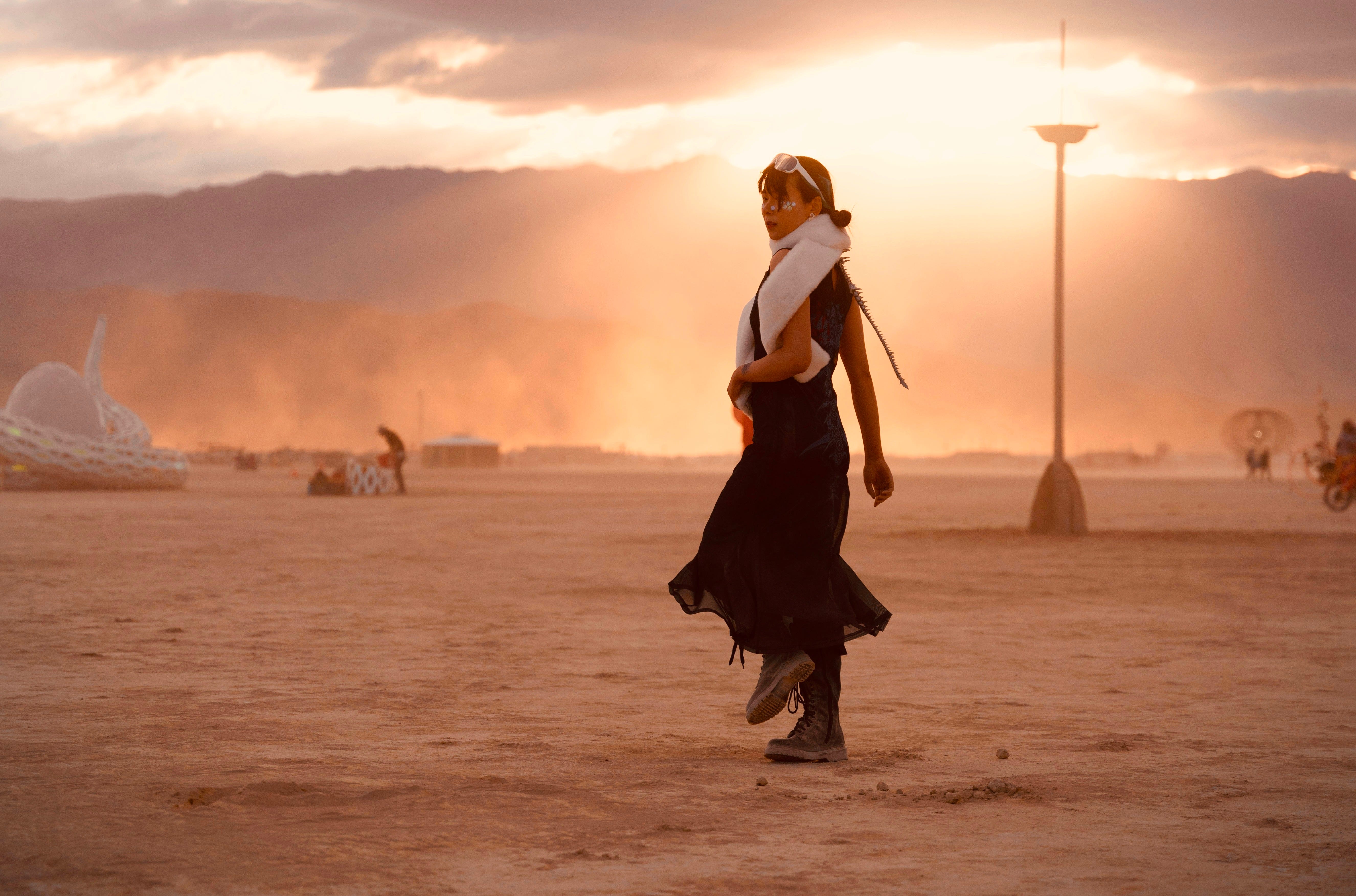
Black Rock City, too, is a kind of wasteland.
Geologists tell us it was once the bed of Lake Lahontan, which dried up ten thousand years ago. But to me, this has always seemed the poorest possible account of the place. I cannot quite believe the lake ever dried up. Its waters merely found another way to flow—through the wind. They have form still, grain upon infinitesimal grain: dust. And every grain of that dust may once have been something else: A corner of last year’s Temple. A rib from the Man the year before. Ash trapped in the hardened mud of the great storm three years ago.
The Stoics believed that the universe would periodically perish in a great conflagration, only to be born again, down to the last detail: the same people speaking the same words.
I wonder whether any of them ever came to a place like this.
In a world where everything is made of dust, to possess someone and to erase them may be one and the same gesture.
Whenever the wind rose, I knew the dust had come for me. It tore through the city like some feral thing. One pounce, and it had me. It slapped my face raw, then licked its way into my hair, the folds of my ears, under my fingernails. I clamped the mask over my mouth and nose. It squeezed through anyway—and stayed, as if it owned the place.
There were moments I thought the dust would kill me. My eyes burned too badly to open; the road had been swallowed whole. Still, I felt no fear. Something in me was almost elated—as though a lover who had kept his back to me for years had finally turned, and without a word, seized me in his arms..
The wind scoured the desert until even its boundaries went blunt: the one between me and myself, the one between me and the world. With those lines rubbed away, there was nowhere to hide. Nowhere, either, to lose myself.
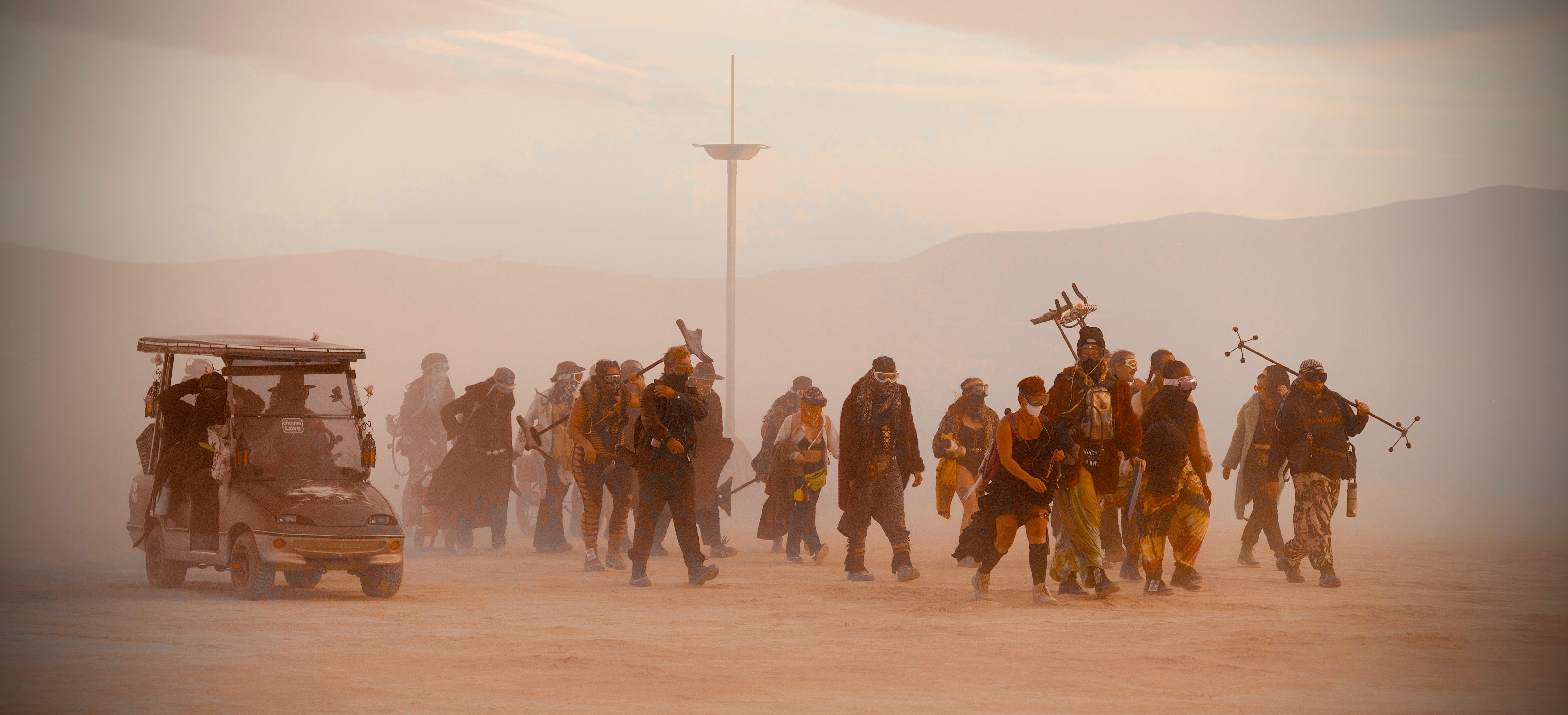
Here, I was certain: wherever I wandered, someone would find me in the dust. Someone would come toward me
This was logic, not hope.
Though I must admit, I’ve never been particularly good at telling the two apart.
And indeed, people found me.
One arrived with a sudden weight beside me. I turned to find a woman who had somehow materialized out of nowhere. Two dark-brown braids hung neatly against her cheeks. A wispy fringe nearly touched her eyes, large and bright as the last two pools of clear water on this parched alkaline flat. When she smiled, a breeze seemed to pass over the water, sending little rings of wrinkles across its surface. There was something both girlish and world-weary about her face.
She wasted no time on pleasantries.
“What’s your spirit animal?”
“Tanuki,” I said, offhandedly.
She looked puzzled. I tried to explain with my hands: something like a raccoon, something like a cat, and a creature given to shape-shifting.
She nodded, committing herself to no particular understanding. Then she produced a brand-new cloth bag, spread it over her knees, and set to work with a pen. The ears came first—my cat, presumably. Next, a ringed tail—the raccoon, I imagined. She worked in fits and starts, with the grave persistence of someone attempting a task for which she had little talent but an unshakable sense of duty. By degrees, an animal took shape. The longer I looked, the more it resembled a pampas cat from the Andean foothills.
I did not correct her. Each time she hesitated, I resolved to believe a little harder.
At last her pen stopped in midair. She lifted those luminous eyes to mine. I gave her a nod, a smile, and accepted my tanuki.
Then came an American man, built like a bear, his great beard streaked with white, who waved me over.
It was a sweltering afternoon, and I was worn out. He invited me to lie down, slipped a blindfold over my eyes, and began passing things across my skin. First my arm, then slowly up to my shoulder, across my chest, down toward my navel.
At first, I kept a wary eye on his hands as they traveled over me, alert to where they might go next. But gradually, I began to feel the stillness beneath their movement. Tender, without a trace of seductiveness. His touch asked nothing of me, and meant to carry nothing away.
I lay there. Without warning, my eyes stung.
My body understood before I did: it had been so long since anyone had touched me this way.
His movements were unhurried, almost ceremonial, as though he were making the introductions himself: Something pointed and cool. Something blunt and yielding. Something furry. Something bare.
I guessed at each visitor and was wrong nearly every time. When the blindfold came off, the strangers revealed themselves: the back of a spoon, the tip of a brush, a dishwashing sponge. I had handled these things a thousand times, yet never once considered what they might feel like from the other side.
I had lived in this body much the same way.
Another found me at an intersection. I was pedaling furiously, trying to find a camp I’d never been to, convinced I was going to be late for their workshop. It was then a tall man in a headscarf flagged me down. He wouldn’t hear of letting me pass without a cup of tea.
He spoke as though I would be doing him a kindness. Just a minute, he promised. It wouldn’t keep me from anything important.
At last I gave in and turned toward the stall.
The wind had stripped the canopy nearly bare, exposing a crooked skeleton of poles. Behind it stood a woman in red, her eyes swallowed by goggles, her mouth buried beneath a mask. Not a trace of her face was visible.
Yet a name I hadn’t spoken in ten years rose to my lips, unbidden.
I tried it aloud.
She answered.
“I had a feeling it was you when you rode past.”
She bent low, turning her back to the wind, and served me a cup of tea.
Dust sifted into it. We both drank it.
Ten years earlier, during a summer internship by the Charles River, I had imagined more futures than I could count. Not one came to pass. Yet not one of them had contained this battered little shelter, trembling in the wind, or this cup of faintly bitter tea.
We like to believe the future is ours to draw, stroke by careful stroke, every line neatly in place. But perhaps the future has been standing at some crossroads all along—a little windblown, a little worse for wear, waiting patiently for us to pass by and recognize it.
Farther down the road, a boy of seven or eight emerged and gave me a proper little bow. Then he placed a key he had made himself into my palm.
His father was a fair-skinned Japanese man with fine, almost scholarly features, wearing an enormous cowboy hat pulled nearly to his eyebrows. The hat had no business sitting on such a face. But the man stepped forward, took my hand, and spoke in halting English, laying out each word with extraordinary care.
“This key will open every door in your life. Please hold on to it. Always. Never give up.”
The utter seriousness of him, the way he offered those words without the slightest reservation, made me, for a moment, forget how to be embarrassed.
On an ordinary day, I might have rolled my eyes at such a terribly proper promise. But that day my throat tightened. The words rose to my lips; all that came out was a thank you.
I did not tell him that I had just come from a cliff beyond day and night. There were no doors there. Only the bottomless dark.
More often, though, it wasn’t people who found me.
Sometimes it was an iron horse, rusted a deep red, its whole body smoldering with a dark fire in the setting sun. It held its neck out and stood quietly, almost humbly, yet seemed to pin the entire dry lakebed beneath its hooves.
Or a strain of jazz after midnight, leaking from some passing art car, a sound so faint, so elusive, it drew me toward the depths of the underworld. I followed it for as long as I could, yet never learned its name.
Or the great wooden skeleton of a dragon, stretched across the alkaline flats, its ribs arching upward one by one in stubborn defiance. I wondered if this was the posture in which some elder god had fallen.
Or a lionfish, its spiny plumes glowing faintly as it swayed through the dark. It granted me no more than a glimpse before drifting away.
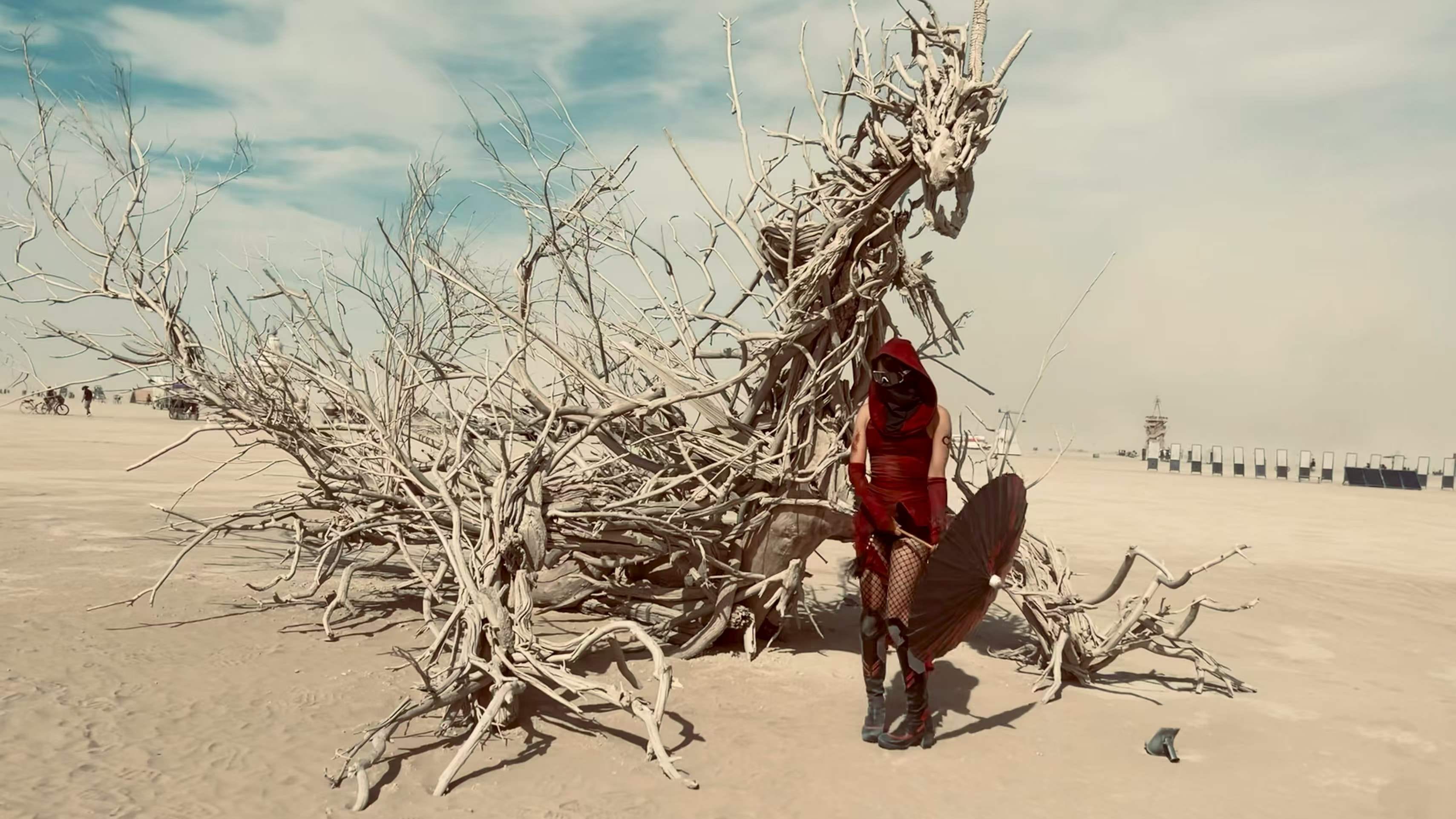
Most often, they appeared when I could walk no farther, or no longer knew where to go.
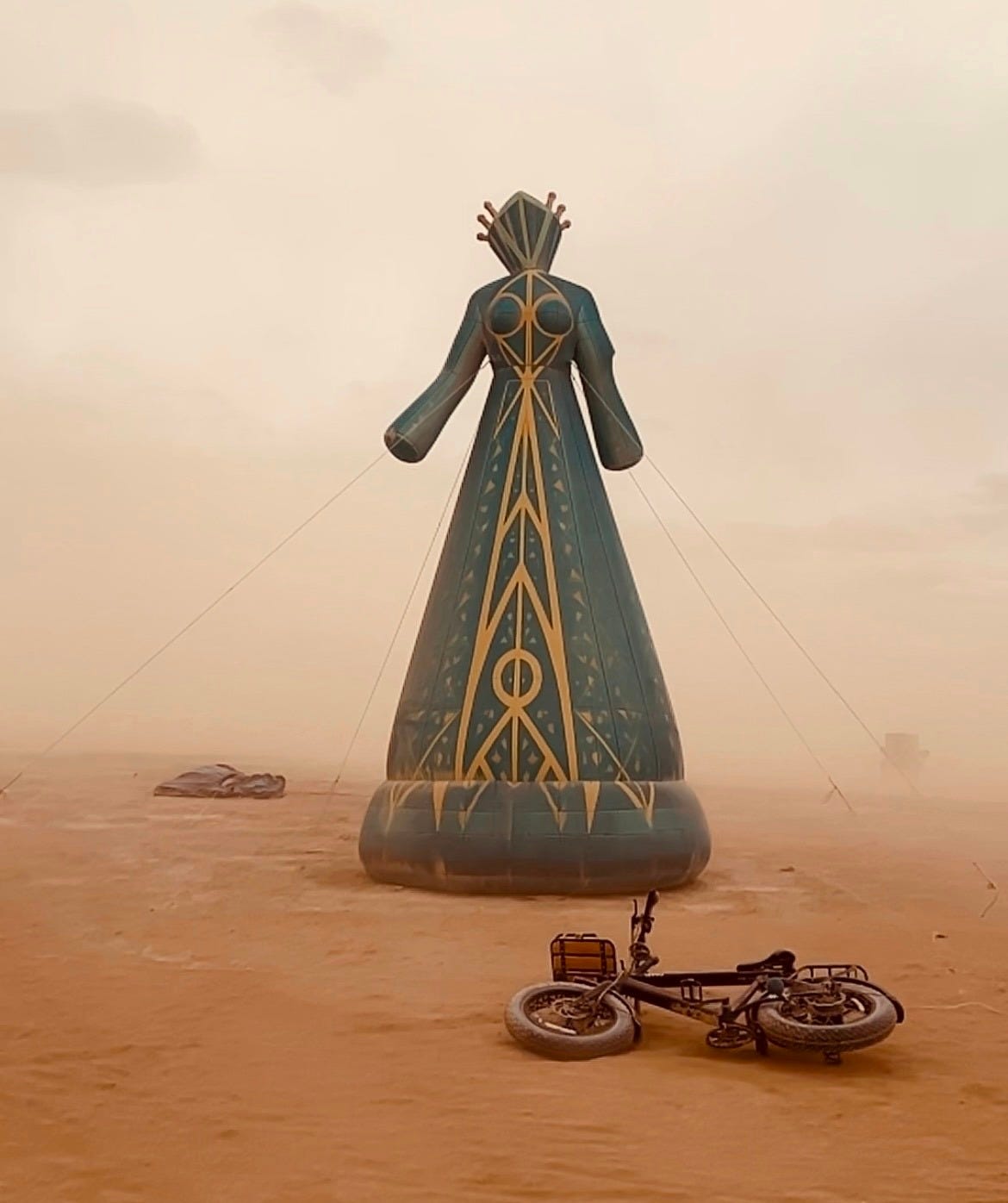
The Faceless Queen, for instance. She stood at the edge of the desert, planted in a dust storm fit for the end of the world. Her body shuddered from side to side, on the verge of falling, yet stubbornly holding on to her last breath, as though she had been waiting for me.
I stood before her for a long time.
She had no face. Where an expression ought to have been was an emptiness like the mouth of a well.
I tipped my head back and looked into it.
I saw the lake.
Ten thousand years ago it had not yet dried up. Its waters were deep. Perhaps the lionfish had swum here from that time. I saw the iron horse break into a gallop, then collapse one morning when I would never come to meet it. I saw the dragon’s ribs when they were still the branches of a tree, with birds building nests among them. I saw a mother tuck a photograph of her dead child into a crack in the Temple’s wood. I saw the braided woman teaching a child to draw a tanuki amid the ruins of a continent ravaged by war. I saw the Japanese boy grow into a man, lose his key, and find it again in an old drawer. I saw summer nights on the Charles River, our young eyes wide beneath the fireworks of the Fourth of July. I heard that phone ring, again and again, unanswered.
I saw the faces I had loved. One by one they faded, until they overlapped into a single face, then turned to ash, turned to wind, were swallowed by a wasteland frozen to the bone and breathed out again—a crowd of naked people running across the earth, where there was no language, and no time.
I saw myself standing before a woman, staring hard into her face.
Then the wind came.
Dust flooded my eyes. I rubbed them and looked again.
There was nothing on her face.
3.
Sooner or later, every wanderer must lose their way in a dust storm, deep in the desert after midnight, searching for home.
At first the wind merely stiffened. Then the dust came at us in walls, and the world stopped less than six feet from our faces. Each breath squeezed thinner on its way in through our goggles. It was as though we had fallen into a pocket of airless void. Sky and earth lost their distinction. North, south, east, west—gone. The stars, the moon, gone. Even the strange, luminous creatures that roamed the desert after dark had vanished. The wind had taken them too.
We pushed our bicycles into the dark, teeth clenched. Whatever counted as forward was no longer ours to decide.
Then, at the end of all possible roads, an orange glow surfaced through the dust.
Closer, it resolved into a small wooden cottage. Three walls, no door. As though a page had blown loose from a fairy tale and landed in the desert.
Inside stood a wooden table, flanked by two long benches, with four people gathered around it. One was bent over some sewing. Another was writing. Others talked in low voices. Outside, even the sky had vanished. But none of them looked up.
A denim jacket hung from a coat rack on the left. Its owner was nowhere to be seen. I imagined he had been called away on some urgent errand, so suddenly that he had forgotten his coat. The others—old friends, I decided—had stayed behind to mind the house, passing the endless night in a conversation so old it had lost both its beginning and its end. Perhaps he was the one the house was waiting for. Perhaps he would never return, and none of them would think to ask.
This time, no one came toward me. The house simply stood there, alight in the dark.
For a long while I remained where I was. Gust after gust sent dust sweeping across its threshold; for an instant, the grains flared bright in the lamplight before the darkness swallowed them back again. I dared not blink, for fear the house would vanish. Nor could I bring myself to approach it. One step closer, I feared, and this enchanted refuge might collapse into a magician’s sleight of hand.
The truth is, I had long since learned to endure having nowhere left to turn. Desperation, like every other feeling, had its season; it came and went like the monsoon. In the years outside Black Rock City, I had repeated a certain incantation until I knew it by heart:
no one is coming.
I had lived by its instruction through so many solitary days and nights that I had even learned to strike a proud pose about it.
So what startled me was not the sight of a glowing house in the middle of the desert. After all, in Black Rock City, anything was possible.
What startled me was myself.
I wanted to run inside. I wanted the house to take me in and keep me forever.
I needed it.
All along, I had wanted a place like this with a force I had scarcely admitted to myself.
By the time I realized what I was doing, I was already inside.
To my right stood a large bookcase. Someone had left a guestbook open on its counter. I went over and wrote:
i love this game
The words were not mine. Someone had given them to me many years ago. More than once, half in earnest, half in jest. Then that person left. The words did not. They had hung in the empty air beside my ear ever since, like a coat nobody had come back to claim.
Now I hung them here.
In a few days, the house would burn, and the words with it. I couldn’t bring myself to regret it. Strangely, the thought seemed to draw me nearer to everything in the room.
We took our seats at the table. Beside us sat a man and a woman, both about our age, facing one another. They exchanged a few words, then fell quiet, then talked a little more. Sometimes they simply sat. They had the air of people who had lived in that house for years, perhaps decades, long enough for the dust to turn their hair and eyebrows white.
Then the man turned to me.
“Geometric shapes, or little fish?”
I stared at him.
He reached beneath the table and produced a heap of odds and ends. Only then did I understand: he was making me a pair of earrings.
“Little fish,” I made my decision.
He bent over his work and began threading together two tiny fish skeletons, bone by bone. Slowly, carefully. Their pale ribs caught the lamplight.
As I took the little fishbones from him, something fell into place.
Ever since arriving in Black Rock City, I had heard people calling out to me, Welcome home! At first, I took it for a customary greeting. I smiled, nodded, and returned the sentiment in much the same spirit as one answers How are you? I had heard the words so often that I scarcely noticed them anymore. Only now did I begin to taste what they meant.
Home.
Such an ordinary word. So ordinary that you might not even remember the last time it left your lips. And yet, how necessary.
In the apartment where I live now, there are scratches on the table and dust on the floor. Those things must know me well enough by now. But a home, it seems, is not quite that. Perhaps home is coming in from a storm in the middle of the night, and someone asking, Geometric shapes, or little fish? Then bending over the table to make them for you, slowly, with care. Perhaps it is someone still waiting by the fire, however late you return. Someone who does not disappear without a word when you least expect it.
I looked up. The two of them were still sitting face to face. Neither had left their seat.
Then something began to rattle against the eaves.
Rain. People appeared from nowhere, as though a flock of migrating birds had stopped to rest along its passage. Each found a corner in which to set down a rain-soaked body and let it dry for a while. I shuffled farther along the bench to make room, and felt, rather absurdly, the private satisfaction of a host who had been expecting company all along.
There was plenty of night left. We began playing a game with poetry cards at the table. They lay face down; no one knew what the next card would hold.
The woman drew one.
“…Dust.”
She read it aloud. Her voice was soft, the words coming and going in the wind.
The man drew another.
“...Sitting by the table.”
I can no longer remember the verses themselves. Only those two keywords remain, so perfectly, so matter-of-factly fated that I began to suspect it was not they who had drawn the poems, but the poems that had chosen them. Or perhaps the two of them were lines the desert had written long ago, and tonight someone had simply read them aloud.
Gradually the dust settled. The wind slackened. The night cleared again, and a notched moon hung askew in the southeastern sky. From the tip of its blade, time flowed in slow pulses, silently rising past our ankles.
For the rest of that week, I never came upon the little wooden cottage again.
4.
Twenty-five hundred years ago, in the open-air theater on the southern slope of the Acropolis, tragedy had a habit of reaching a dead end. A hero had committed a crime beyond redemption. Oaths collided with oaths; fate tightened into a knot no mortal onstage could undo.
Then, from behind the scenery, came the creak of a wooden crane. Its arm swung slowly into view, and down from the air descended a god.
At the end of Euripides’ Orestes, Apollo arrived in just this fashion, settling a murderous feud among kin with a few words. Medea, having killed her own children, escaped above the rooftops in the sun god’s dragon-drawn chariot. The Greeks called the contraption mēchanē. Later, Latin gave the dramatic device its name: deus ex machina. A god from the machine.
The Man was a deus ex machina made real.
He had no business standing on that vast, desolate playa. Yet there he was, solid and impossible, like a blade cleaving earth from sky.
But whereas the Greeks concealed their crane behind the scenery, allowing the audience to believe a god had descended from heaven, the people of Black Rock City raised their god in full view, timber by timber. And when the play was over, the very hands that had raised him would set him ablaze.
To give myself over to Black Rock City was to join a provocation against the Creator—or so I believed in those first days. I must confess, I thought I had finally found the fight I’d been saving myself for.
After all that searching, an opponent almost impossible to defeat.
Look, Creator. You think these finite bodies of ours are yours to command. When we are born, when we perish, what counts as an instant and what as eternity—you alone get to decide. You think we can do nothing but submit to your will: suffer the indignity of being toyed with and nurse our injuries in silence, or else pant and strain after that thing called immortality, like a donkey yoked to a mill, chasing the carrot forever dangling before its nose?
No.
We have never asked to be immortal. We beg for no blessings, recoil from no curses. Neither optimism nor despair has anything to do with it. Our pride lies not in leaving behind some monument that will outlast us, but in building, with our own hands, a universe in which the power of life and death belongs to us!
I believed every word of this.
Until the night we burned the Man.
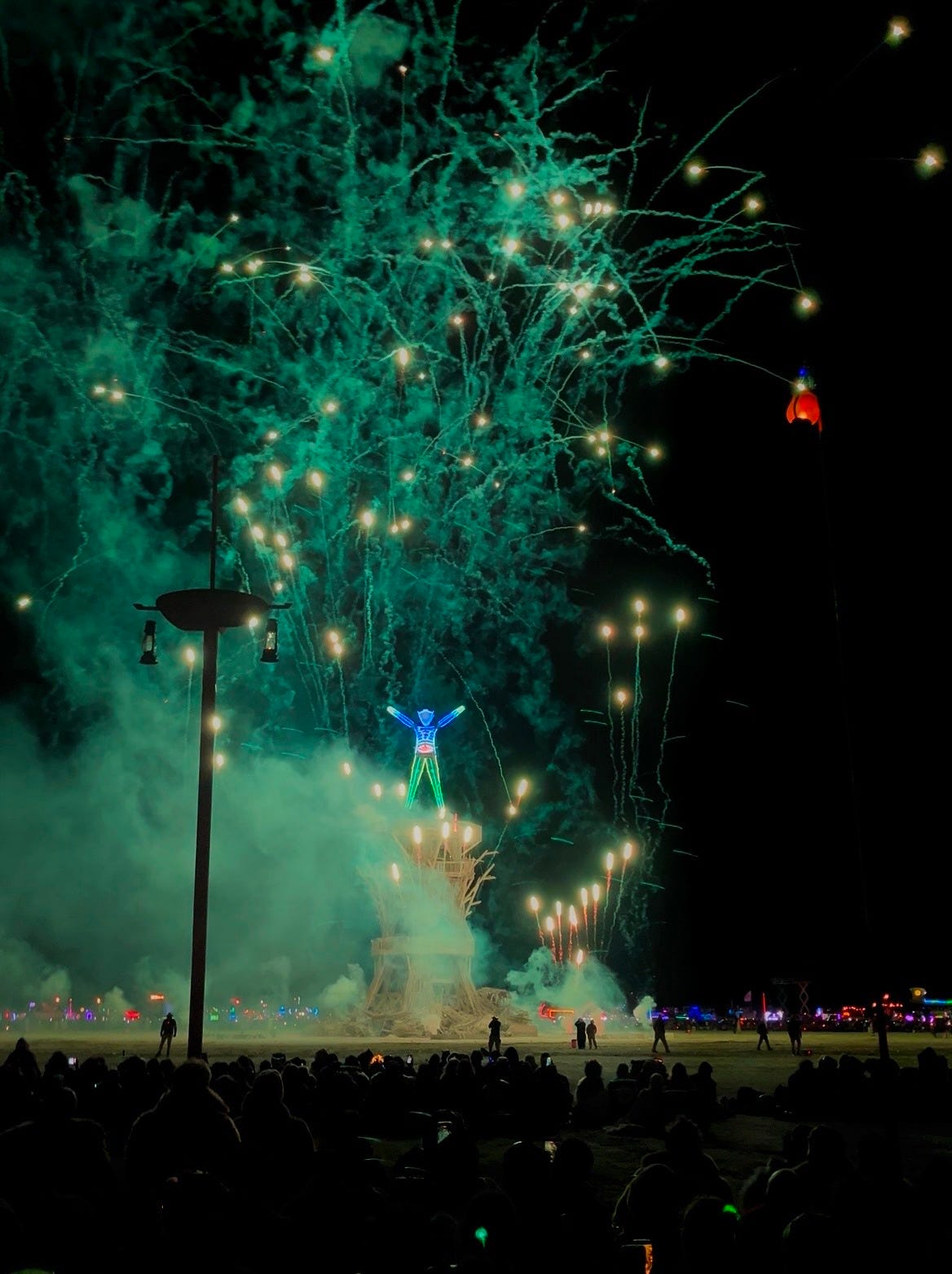
If an eye were watching from high above the desert, it would have seen light beginning to gather at the center of a dark lakebed stretching for hundreds of square kilometers. From every direction, the art cars converged upon the heart of the playa: birds and beasts, demons and specters. Fire erupted from some; light poured from others; wings and antennae stirred against the dark. Slowly they spiraled inward, like galaxies yielding to the pull of a common center.
There they took their places, ring within ring, standing at attention like soldiers assembled for inspection, with the Man at the center of it all. The precision of their arrangement seemed older than humanity itself, as though it had been inscribed in the laws of physics long before there were human eyes to witness it.
And suddenly I saw it.
This was how the universe had always worked.
A star burns in the dark for billions of years, fusing hydrogen into helium, helium into carbon, burning its way to iron. When there is nothing left to burn, it collapses inward, then bursts apart, casting into the void, light-years away, the elements it has spent its lifetime forging.
Billions of years later, from those ashes grew oceans. Eyes and hands. And seventy or eighty thousand people, standing at that very moment in the Nevada desert.
So when we raised our own gods from the machine, grit in our eyes and veils across our faces, sweat running down our skin, our throats scraped raw from shouting, and then, in a frenzy of joy, gave them to the flames—we were only doing, in our finite human bodies, what the universe had done before us.
Beginning it all again.
Was this really a challenge to the Creator?
Or had there never been a contest at all? Had we, in these finite bodies, been holding up a mirror to that power on high—humbly, earnestly, giving visible form to the Creator’s infinity?
I lifted my eyes.
Ring upon ring of light spread across the dry lakebed, a field of stars burning on the earth.
Hundreds of machines. Tens of thousands of hearts. All turned toward one center.
No one had issued a command.
The universe never does.
I had seen this order before. Yet every time, it left me standing as the first human must have stood beneath the stars—holding my breath, not knowing what to say.
5.
The night after the Man burned, it was the Temple’s turn.
All week, I had watched people enter the Temple with something tucked against their chests: Photographs, letters, rings, a dog’s collar, names inscribed on wood. And things no hand could carry: a marriage, a former self...
The Man had been hollow. We’d built him ourselves, and when the time came, offered him to the flames without regret. The Temple was different. The Temple was full, and nothing inside it had been given up freely. Still they came, again and again, to lay down what was beyond keeping. What was beyond saving.
That evening, Uncle Will’s dinner bell rang as it always did, its cheerful clatter calling us home like children released from school.
Will and his wife, Jen, had tended the camp kitchen from morning till night, three meals a day, never failing us once. In Black Rock City, you could forget what day it was, even what hour. But Bill’s bell would ring, and however far we’d wandered, we came home.
I stood beside the dinner line, plate in hand.
“Will, are you going to the Temple tonight?”
“Hope I can make it,” he said, stirring the pot.
After a pause, he told me he’d had a son. Ten years earlier, the boy had died of a heroin overdose. He had never come home.
Will said this as he stirred, and he was still stirring when he’d finished.
After dinner, I caught sight of Andrea wrapping a scarf around her head. Her silver hair disappeared beneath it.
By day, she was radiant, her eyes lighting up whenever she smiled, her short silver hair setting them off beautifully. But that evening, she lingered beside her bicycle before climbing on. Dusk pressed in, until I could barely make out the half of her face turned toward me.
Andrea had told me she was sixty-six years old and lived alone in San Miguel, Mexico, in a house of her own design, its walls covered in butterflies. She had traveled to China several times, always to accompany her son to ice hockey tournaments.
She had come to Black Rock City alone this year, to fulfill a wish her son had not lived to see.
Her bed was opposite mine. She slept so quietly that at night I could scarcely hear her breathe. Once, returning in the small hours and groping for something in the dark, I had tried to move without making a sound, only to hear her say, “Don’t worry about me.” She didn’t open her eyes.
Now I watched Andrea ride away into the gathering dark.
I did not call after her.
There was no cheering that night. No music. Tens of thousands encircled the Temple, just as they had the Man. But this time, the silence was deafening. Even the dragon and the lionfish seemed tamed by the immensity of the mourning. Their dazzling colors held still against the dark as they watched the timbers burst apart. The wind caught the heart of the fire, wrenched it sideways, then let go.
All those birds and beasts still shimmered before me on that final night. Yet I had already begun to watch them as one watches shooting stars: light that had set out long ago and was even now slipping away.
I looked around. Everyone I had come with was gone. I couldn’t tell when we’d parted, or where they’d gone. The crowd had dissolved into a multitude of indistinct silhouettes. Not a single face I knew.
Like a child lost in a dream, I stood where I was, afraid to move.
I had believed so fiercely that wherever I wandered, someone would find me in the dust. Yet even here, in all of Black Rock City, there were moments when no one came for me. And the very people who had taken me in on the playa had once watched the person they loved most slip beyond their reach.
Howls broke out suddenly. Beneath them, someone began to sing a lament, barely above a murmur. A few lines, then silence, as though the song were meant for someone near enough to hear.
I knew what the night wanted of me.
Tears.
I wasn’t going to oblige. I had left nothing in the Temple. The words I’d written were already at the far end of the desert, in a little wooden cottage without a door. I’d never thought the most private feelings belonged on display. Not even the Temple had the right to keep mine.
The Temple—a wooden lotus of such improbable beauty—hardly seemed real. Everyone called it the Temple. Seven days in, the word still felt foreign on my tongue. I touched its tip lightly to my upper teeth and sounded it out: temple. It was like reading aloud the salutation of a letter addressed to someone else.
Kundera wrote that kitsch draws two tears from us. The first says: Look, how moving this is. The second: How beautiful, to be moved together with all humanity.
I wanted neither. I stiffened my neck and raised my chin. Something hard was drawn tight inside my chest, pressing against me until it hurt. And yet, at that very moment, I felt a thin warmth making its slow way down my skin.
I remembered someone who had once studied my face with painstaking attention, then exclaimed, as though discovering a tiny insect:
“There’s a tear on your neck!”
Thankfully.
Though—what a pity—
Only that one.
6.
When I woke up, Andrea’s bunk across from mine was empty.
I pulled on my shoes and ran outside. The kirtan chanting from before dawn had already scattered on the wind. Our camp’s great pyramid had been stripped of its canvas skin, leaving only the bones. Not one of the elephants that had migrated across its canvas to the beat of drums the night before remained. Farther out, the towering landmark at the center of the universe had vanished, leaving a black scorch mark on the ground.
No phoenix rose from the ashes.
I tried to take it all in, as one tries to hold on to a dream upon waking. The harder you strain to remember, the faster it dissolves.
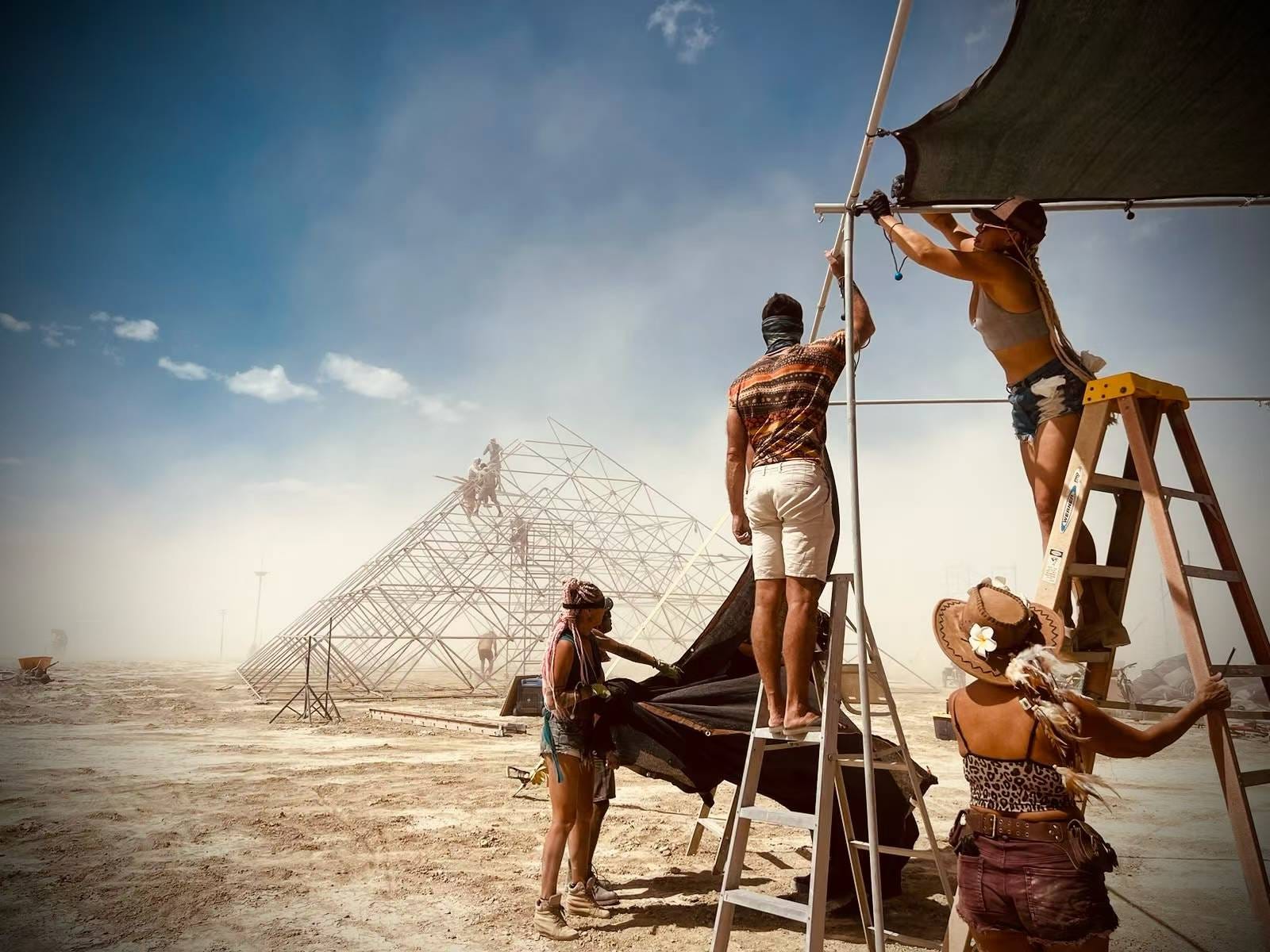
Most of the familiar faces were gone. A few figures still worked in the dust, taking the camp apart. Like butchers, they dismantled the skeletons they had raised only a week before, joint by joint.
I glanced at my phone. A message from a friend:
Left early this morning. Didn’t get to say goodbye. See you next time!
Some farewells happen before we know it. Others need never happen at all.
I crouched beside the camp’s toolbox, coiling loose lengths of nylon rope. The wind and dust had worn several of them through, leaving only short, frayed ends. I held two broken pieces together. There was no joining them; I knew that. Still, I spent a long while lining them up before winding each one separately and putting them away.
Perhaps we are all inclined to expect a certain completeness from our stories. Causes must have consequences, encounters must have reasons. We imagine that everyone who enters the scene has been planted there for something yet to come.
The Creator, unfortunately, seems to have little regard for neat stitching. Now and then, halfway through a piece of work, he simply puts down his needle and leaves the thing as it is, quite unashamed of its peculiar shape. There is a story that when the first platypus specimen arrived in Britain, naturalists took a pair of scissors to it, hunting for stitches around the bill. Surely some taxidermist was having a laugh.
There was the long-haired man with thick eyebrows who came looking for me at camp, carrying a Soulmate Questionnaire covered in my handwriting. I was hurrying to the kitchen when we met. We spoke for five minutes, politely and with every consideration, as though I were merely giving a stranger directions at a crossroads.
We got in touch again afterward, but neither of us took the conversation much further. Sometimes I think of him back in Colorado, getting on with whatever life was waiting for him there. Some threads are already too short by the time they reach your hands. I can’t say I regretted that one.
And then there was the friend who watched the Man burn with me, who wandered the playa at my side until dawn, as though we’d strayed into Before Sunrise. So many coincidences had brought us together that, for a while, I was certain fate had written the whole thing in advance. Back in the city, we did watch Before Sunrise together. But Before Sunset and Before Midnight—the other two films in the trilogy—never followed. For one reason or another, we left them unwatched.
Perhaps he had come to our meeting from a life already well underway. Perhaps I had written rather too many of his scenes for him.
So many loose ends will never be tied. Let them hang. The desert wind will give them a little sway.
7.
Back in San Francisco, I punched the numbers into the keypad by my door. A click, and it opened. Funny, how the key the little Japanese boy had given me—the one that would open every door in my life—was of no use at my own front door.
I still haven’t unpacked my backpack. It sits in plain sight in the hallway, filmed white with dust. Every time I pass, a little more shakes loose. Bit by bit, Black Rock City is leaking onto my floor.
When I lay down in bed, the soles of my feet were still cold, as though there were something beneath them.
Frozen earth.
The wasteland was frozen to the bone, its ground split open in long cuts. The scales began falling from my body again, each one bearing a word. This time I didn’t run. I crouched and gathered them, one by one. They were poisonous, hot against my fingers, burning hotter the longer I held them. Still, I turned each one over to look.
The first read Results. I’d spent half my life chasing them. Now they lay in my palm, a single little scale, lighter than I’d imagined. Beneath it were several larger ones, bright with gold. Where they had fallen, they had burned deeper holes into the earth.
I picked up Glory. It was the brightest, almost painful to look at. But when I turned it over, the other side was blank. Not a word.
Eternity was cool and slick, without a single groove. Set anything beside it, and suddenly that thing seemed too brief.
Then came Creation. Its edges were ragged, like paper cut in haste, the ink still wet enough to smear my fingers. I’d thrown it away more than once, only to turn around and go back for it.
I picked up Rescue. It curved into the shape of a hand, palm turned upward, waiting for someone to take hold. I’d stood at the edge of that cliff for years with it clenched in my fist. Holding on to it, I could go no farther.
And then Love.
It was the softest. On one side was written to love; on the other, to be loved. The two faces clung so closely together that I had never managed to peel them apart.
The scales piled up in my palm, then slipped away, mingling with earth and ash. They rose and receded like a tide. Those I held burned; those that fell cooled slowly in the soil.
I’d always thought the world had written these words upon me. Judgments or spells, I couldn’t quite tell, but surely they had come from someone else. Yet as I turned them in my hands, the handwriting began to look familiar. The ardor of that horizontal stroke, the quick flourish of that hook—I knew them. Every stroke had passed beneath my own hand. I’d traced them again and again, bearing down harder each time, until the marks were deeper than before. So deep that, eventually, I could no longer tell which scales had been planted by others and which had grown out of me.
They had grown against my skin all these years, and I had grown to fit their shape, trying to become someone worthy of the words. The closer I came, the harder they bit, fastening themselves to my flesh, refusing to let go. Taken together, these were perhaps the full weight of what I’d carried all these years.
I knew every scale.
Yet, not one bears a word for who I am now.
It began to snow. Far off, a naked figure was turning in circles in the wind. I couldn’t make out who it was. Perhaps a child who had never come home. Perhaps another version of me, in some parallel universe, who would sooner freeze to death than stop running.
The snow came down harder. She kept turning, her outline fading into the white. No one went to her.
At that moment, I wanted to take her in my arms, to brush the snow from her hair. I wondered if she would recognize me.
I rose and ran.
Each step sank deep into the snow. The cold cut into my bare soles until, after a while, I could feel nothing at all. Behind me, the snow began to melt, leaving one crooked hollow after another.
My footprints. They joined to form a word. Each step wrote another stroke; behind me, one dissolved. A word no one had ever finished writing.
I did not look back.
It wasn’t a scale. I couldn’t pick it up or carry it away. It didn’t need to last.
In that moment, to be alive meant only to be alive. Nothing else.
no one is coming.
Then I’ll go myself.